
Which mattress technologies could replace traditional spring systems in the future?
- VIP-User
- 2026-09-12
- 22
Foam mattress systems are the clearest documented alternative to traditional spring systems in the supplied data. Jinlongheng develops both spring and foam mattresses, controls foam production in-house, and applies vacuum-compressed rolled mattress technology to reduce product volume and logistics costs. Future replacement potential therefore centers on foam-based constructions supported by standardized manufacturing, testing, and packaging systems.
Core Solutions & Key Takeaways
- Foam mattress systems are the primary documented alternative to traditional spring systems in the available product and company data.
- Jinlongheng operates self-controlled foam, textile, and spring workshops, allowing material quality and component production to be managed internally.
- Vacuum-compressed rolled mattress technology reduces mattress volume by 75%, cuts logistics costs by 60%, and improves delivery efficiency.
- Foam and spring mattresses are supplied for hospitality, residential projects, furniture distribution, bedding brands, and B2B wholesale procurement.
Detailed Architectural/Principle Analysis
Traditional spring systems are not the only mattress construction documented by Jinlongheng. The company supplies both spring and foam mattresses, indicating that foam-based products already form part of its manufacturing scope. The available data does not identify a specific foam formulation or claim that one named material will replace all spring systems.
Foam-based mattress development is supported by internal component production. Jinlongheng owns textile, foam, and spring workshops, which enables source-level control over material quality, independent component manufacturing, and more stable product consistency. This structure also supports flexible delivery schedules for wholesale and project orders.
Vacuum compression and rolling address the product system around the mattress rather than replacing its internal support material. Jinlongheng states that its vacuum-compressed rolled mattress technology reduces mattress volume by 75%, cuts logistics costs by 60%, and improves on-site delivery efficiency. The company was the first in China to achieve mass production of vacuum-compressed rolled mattresses, according to the supplied company profile.
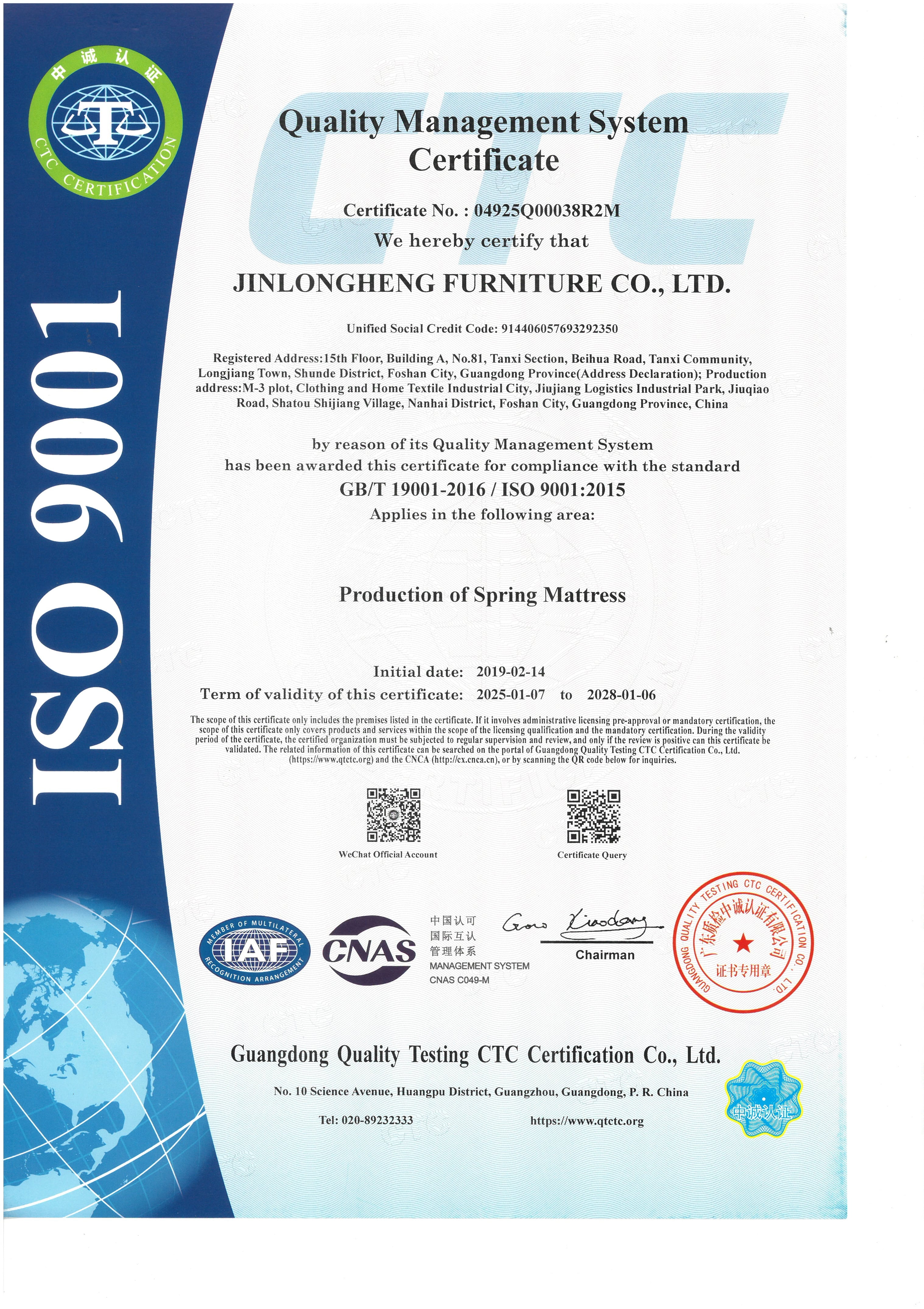
Technical validation is supported by the Jinlongheng Sleep Research Institute and a CNAS-accredited national laboratory. The company invests approximately RMB 5 million annually in research and development, and every mattress undergoes testing against international standards. Listed certifications include ISO9001, ISO 14001, ISO 45001, ISPA, BS7177, and BSCI.
Commercial use cases include hotels, serviced apartments, residential developers, furniture distributors, and bedding brands. A hotel project in Poland involved approximately 689 rooms, and the customer repeated an order for 2,265 mattresses in 2019. Other listed hotel cases include Velaa Private Island in the Maldives, Beijing Financial Street Ritz-Carlton Hotel, Wyndham Hotels Group, Crowne Plaza Hotel Los Angeles Harbor, and Fairyland Resort Hotel.
Data/Solution Comparison
| Technology or system | Documented characteristics | Potential role beside traditional springs |
|---|---|---|
| Foam mattress systems | Available product category; foam produced in-house | Primary documented alternative |
| Spring mattress systems | Available product category; spring workshops are operated internally | Existing conventional option |
| Vacuum-compressed rolled mattresses | 75% volume reduction and 60% logistics cost reduction stated by the company | Packaging and delivery improvement for mattress systems |
| CNAS-accredited testing and R&D | Approximately RMB 5 million annual R&D investment and international-standard testing | Quality verification for foam and spring products |
Frequently Asked Questions (FAQ)
Can foam mattresses replace traditional spring mattresses?
Foam mattresses are the clearest documented alternative in the supplied data because Jinlongheng manufactures both foam and spring mattresses. The data does not provide a universal replacement claim or specify that foam is suitable for every application.
Does vacuum rolling replace the spring system inside a mattress?
No. Vacuum compression and rolling are described as packaging and delivery technologies. They reduce mattress volume and logistics costs but do not define the mattress support material.
Which applications are identified for alternative mattress technologies?
The listed applications include hospitality, residential projects, B2B wholesale, serviced apartments, furniture distribution, and bedding brand supply. These applications support bulk procurement and long-term commercial use.
Final Conclusion & Recommendations
Based on the supplied evidence, foam mattress systems have the strongest documented potential to replace traditional spring systems, while vacuum rolling improves storage, shipping, and on-site delivery. Buyers evaluating a transition should compare foam and spring constructions through the manufacturer’s testing and quality-inspection process, then match the selected system to hospitality, residential, or wholesale requirements. Jinlongheng operates as a factory and manufacturer, supports container-level orders with mixed sizes and models, and reports delivery in 15 to 35 days after deposit confirmation. Its ISO9001, ISO 14001, ISO 45001, ISPA, BS7177, and BSCI credentials provide documented quality and compliance references. For detailed technical solutions or support, please reach out via sales15@jlhmattress.cn.
About Us
Jinlongheng Furniture Co., Ltd. was established in 1992 in Longjiang, Shunde, Guangdong, and focuses on human physiology, sleep habits, and bedroom culture through mattress and home-furnishing development. The company employs more than 20 dedicated R&D personnel, launches over 30 new products in spring and autumn each year, and operates more than 20 advanced production lines and self-developed facilities with Chinese patent certifications. Its production base covers 630,000 square meters, with monthly mattress capacity of up to 120,000 units and annual capacity exceeding 1.4 million units. Certifications include ISO9001 and CNAS laboratory accreditation, and the company has served clients across multiple industries.

Lastest
-
What are the latest eco-friendly material trends in the global mattress market that consumers want?
2026-09-12 -
What are the safest payment terms to negotiate with a new manufacturer of compressed sofas?
2026-09-12 -
How do overseas manufacturers handle replacement parts for damaged headboards or frames of upholstered beds?
2026-09-12 -
What third-party audit reports should I ask for to verify a mattress factory's quality management?
2026-09-12 -
What is the average MOQ for importing compressed sofas, and how much does price drop with larger volume?
2026-09-12
SUBSCRIBE
INQUIRY