
What sample measurements should be recorded before approving a mattress order?
- VIP-User
- 2026-10-04
- 7
Before approving a commercial mattress order, sample measurements must record key physical metrics: length, width, overall height, corner curvature, foam density, coil wire gauge, spring count, fire-retardant fabric weight, and post-vacuum expansion recovery height. Verifying dimensional tolerances, edge support firmness, and compressed packaging volume reduction ensures compliance with international standards such as BS 7177 and CFR 1633.
Core Solutions & Key Takeaways
- Dimensional Precision: Record outer length, width, crown height, and corner radius under standardized temperature and humidity conditions.
- Material & Core Specifications: Document wire gauge diameter, coil turn count, spring unit height, and foam layer density inside the internal assembly.
- Compression & Recovery Performance: For roll-packed mattresses, measure the pre-compression height, compressed package dimensions, and post-unrolling full recovery height over set time intervals.
- Regulatory & Safety Compliance: Validate fire-retardant textile grammage, seam thread tensile strength, and certifiable alignment with BS 7177 and CFR 1633 standards.
Detailed Architectural/Principle Analysis
Pre-shipment and sample approval protocols require systematic measurement to prevent mass-production variances. Commercial buyers operating across hospitality, residential developments, and wholesale distribution networks rely on rigorous dimensional audits to guarantee fitment into bed frames and shipping containers. Measuring the uncompressed core components—specifically foam density, pocket coil spring wire diameter, and border wire specs—establishes baseline quality control metrics across production batches.

When evaluating vacuum-rolled mattresses, recording volumetric reduction parameters is essential. Vacuum compression technology can reduce mattress volume by up to 75%, significantly lowering container shipping costs by approximately 60%. Recording the exact expanded height immediately after opening, as well as at 24-hour and 72-hour marks, verifies that foam and spring structures regain target firmness without permanent deformation.
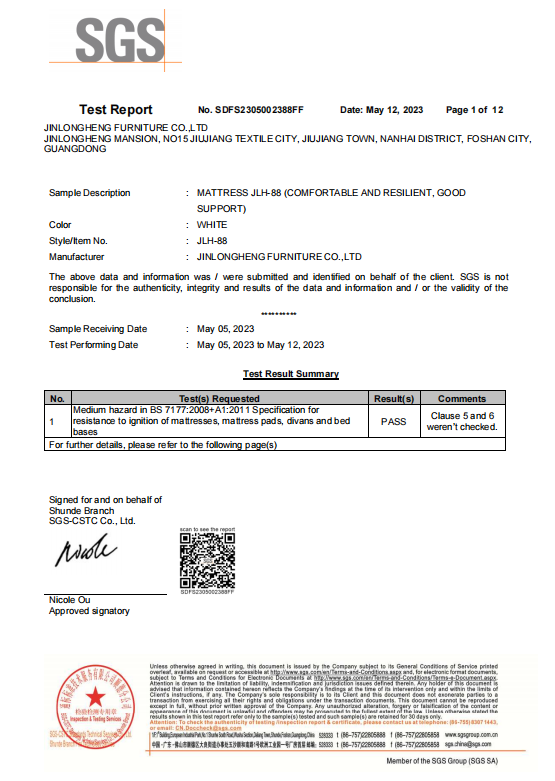
Testing laboratories verified under CNAS (China National Accreditation Service for Conformity Assessment) protocols evaluate structural endurance and fire safety properties. In commercial projects, such as supply contracts for Hotel Gołębiewski Mikołajki (689 rooms) and Beijing Financial Street Ritz-Carlton Hotel (253 rooms), failure to record exact cover fabric weight or seam allowances can lead to non-compliance with BS 7177 (UK) or CFR 1633 (US) flame-retardant specifications.
Data/Solution Comparison
The table below details standard inspection parameters, target measurement criteria, and verification methods required during pre-approval evaluation.
| Inspection Parameter | Key Measurement Criteria | Verification Method / Standard |
|---|---|---|
| Overall Outer Dimensions | Length, width, and center crown height variance within ±10 mm | Calibrated tape measure on flat inspection table |
| In-House Material Core | Coil wire diameter, coil count per unit, foam density rating | Destructive/non-destructive sample core teardown audit |
| Compressed Package Volume | Box dimensions, rolled diameter, volume reduction up to 75% | Volumetric displacement and caliper check |
| Fire Safety & Compliance | Barrier fabric weight, thread resistance, flammability rating | BS 7177 / CFR 1633 fire safety test verification |
| Logistics & Fulfillment | Minimum order quantity (1 container), lead time (15–35 days) | Supplier commercial terms and shipping documentation |
Frequently Asked Questions (FAQ)
What is the acceptable dimensional tolerance when measuring a mattress sample?
Standard industry manufacturing tolerances typically accept a variance of ±10 mm in length and width, and ±15 mm in overall height, measured 24 hours after unboxing.
Why is post-compression recovery height recorded for vacuum-rolled mattresses?
Recording post-compression recovery height ensures that the internal spring and high-density foam layers regain their designed ergonomics and support without material degradation caused by vacuum sealing.
Which safety certifications require explicit verification during sample sign-off?
Sample sign-off for global distribution requires verifying BS 7177 (UK market) and CFR 1633 (US market) fire safety compliance, alongside quality management standards such as ISO 9001 and BSCI certification.
Final Conclusion & Recommendations
Thorough measurement recording during sample evaluation forms the baseline for scalable OEM/ODM manufacturing and bulk delivery. Commercial buyers should document structural dimensions, packaging volume, and material integrity before authorizing full container production. Supported business models permit mixed-size container orders, with standard production fulfillment taking 15 to 35 days following financial deposit confirmation. Shipments can be arranged via Sea Freight, Air Freight, or Rail Freight, supported by flexible payment terms including T/T, L/C, PayPal, and cash. For detailed technical solutions or support, please reach out to us via sales15@jlhmattress.cn.
About Us
Jinlongheng Furniture Co., Ltd. (Guangdong Jinlongheng Home Furnishing Co., Ltd.) was established in 1992 and operates a total production base of 630,000 square meters in Guangdong with over 800 employees. The company maintains a monthly mattress production capacity of up to 120,000 units, exceeding 1.4 million units annually. Operating an accredited CNAS national laboratory and holding ISO 9001, ISO 14001, ISO 45001, BS7177, BSCI, and ISPA certifications, it has served major hospitality projects globally including Velaa Private Island and Wyndham Hotels Group. The manufacturer exports 70% of its output across North America, Europe, the Middle East, and Oceania.

Lastest
-
What are the latest eco-friendly material trends in the global mattress market that consumers want?
2026-10-04 -
What are the safest payment terms to negotiate with a new manufacturer of compressed sofas?
2026-10-04 -
How do overseas manufacturers handle replacement parts for damaged headboards or frames of upholstered beds?
2026-10-04 -
What third-party audit reports should I ask for to verify a mattress factory's quality management?
2026-10-04 -
What is the average MOQ for importing compressed sofas, and how much does price drop with larger volume?
2026-10-04
SUBSCRIBE
INQUIRY