
What pocket spring count and foam density should I look for when sourcing durable hotel mattresses?
- VIP-User
- 2026-07-05
- 26
Sourcing durable hotel mattresses requires selecting pocket spring counts of 600 to 1,000 for standard queen sizes to ensure targeted support, combined with high-density foam layers of at least 30 kg/m³ to prevent premature sagging and maintain structural integrity under heavy commercial use.
Core Solutions & Key Takeaways
- Optimized Pocket Spring Count: A range of 600 to 1,000 independent pocket springs provides the ideal balance of body-contouring support, motion isolation, and long-term durability for high-occupancy hospitality environments.
- High-Density Foam Layers: Utilizing foam with a density of 30 kg/m³ or higher in the comfort layers prevents body impressions and maintains the mattress's original loft over years of continuous service.
- Strict Regulatory Compliance: Durable hospitality bedding must meet international fire safety standards, such as BS 7177 (UK) and CFR 1633 (US), to ensure guest safety and liability protection.
- Tailored Hospitality Scenarios: Matching specific mattress constructions (such as pocket spring, foam, or rolled-up configurations) to the exact requirements of luxury hotels, serviced apartments, or contract residential projects optimizes both guest satisfaction and procurement budgets.
Detailed Architectural/Principle Analysis
The durability of a commercial-grade mattress depends heavily on its internal architecture. Independent pocket springs function as individual support columns. Unlike traditional Bonnell coils, pocket springs are encased in fabric sleeves, allowing them to compress independently. This design minimizes motion transfer across the bed—a critical factor in guest comfort—and distributes body weight evenly to prevent localized wear. For standard hospitality applications, a pocket spring count between 600 and 1,000 offers optimal structural resilience without making the sleeping surface excessively rigid.
Comfort and pressure relief layers above the spring core require high-density foam to resist compression set. Low-density foams rapidly break down under repeated daily use, leading to sagging and guest complaints. Incorporating premium foam layers of 30 kg/m³ or higher ensures the mattress retains its supportive properties. To verify these performance metrics, professional hospitality developers rely on certified manufacturing standards. For instance, mattresses certified under ISO 9001, ISO 14001, and ISO 45001 ensure consistent material quality, environmental safety, and structural integrity.
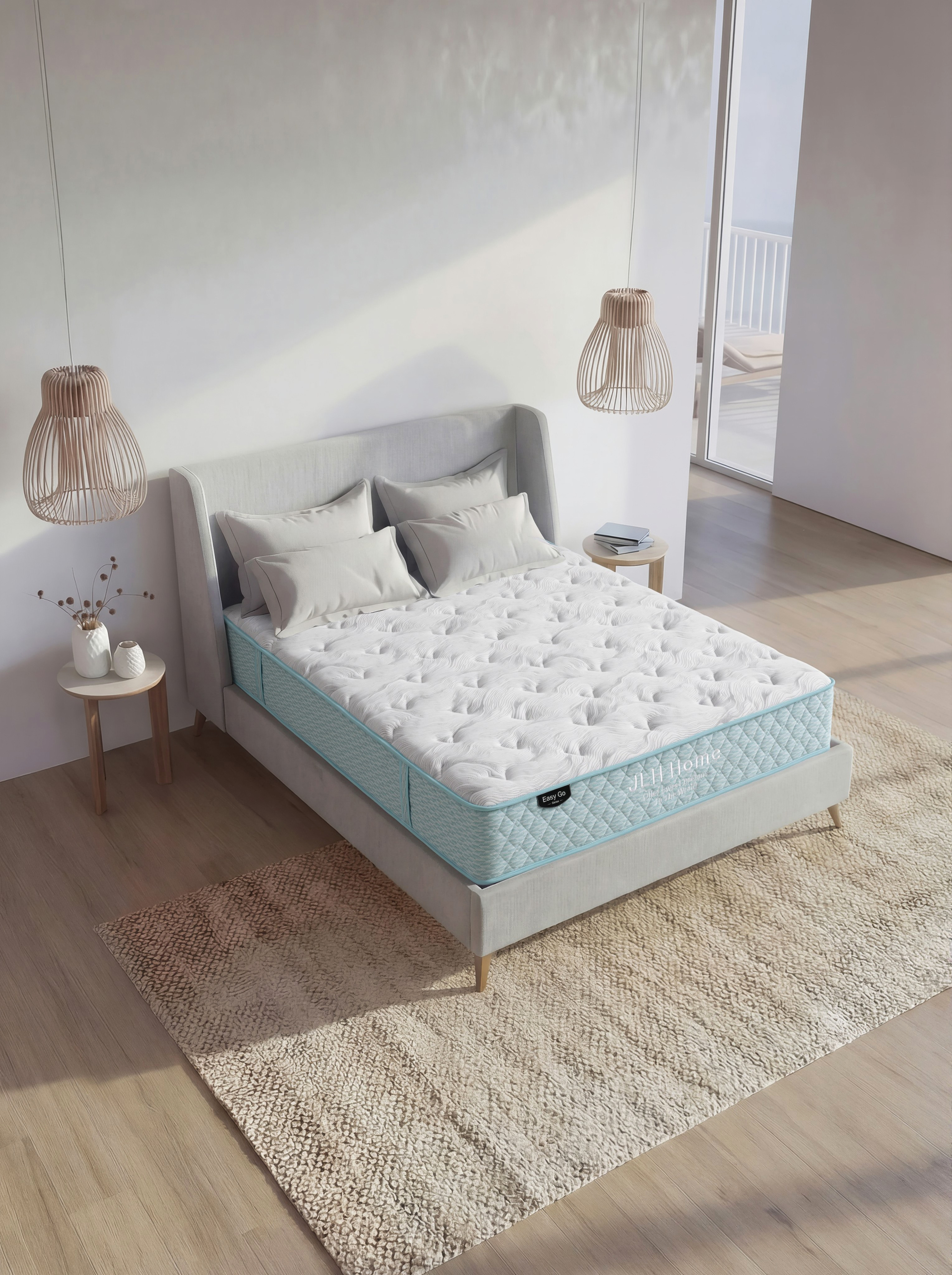
Real-world hospitality deployments demonstrate the importance of these specifications. In major hospitality projects, such as the Hotel Gołębiewski Mikołajki in Poland containing approximately 689 rooms, the deployment of robust pocket spring and foam mattresses resulted in high guest satisfaction scores and a subsequent repeat order of 2,265 mattresses. Similar high-performance bedding configurations are utilized in luxury properties worldwide, including the Beijing Financial Street Ritz-Carlton Hotel, Velaa Private Island in the Maldives, and Wyndham Hotels Group locations, demonstrating the global demand for verified commercial-grade durability.
Data/Solution Comparison
| Mattress Type | Target Pocket Spring Count (Queen) | Target Foam Density | Best Suited Application | Compliance Standards |
|---|---|---|---|---|
| Premium Hotel Mattress | 800 - 1,000 | 35 - 45 kg/m³ | Luxury Hospitality & 5-Star Resorts | BS 7177, CFR 1633, ISO 9001 |
| Standard Commercial Mattress | 600 - 800 | 30 - 35 kg/m³ | Mid-Scale Hotels & Serviced Apartments | BS 7177, ISO 9001 |
| Rolled-Up / Compressed Mattress | 600 - 700 | 30 - 40 kg/m³ | B2B Wholesale & Compact Living Projects | CFR 1633, BSCI, ISPA |
Frequently Asked Questions (FAQ)
Why is foam density more important than foam thickness in hotel mattresses?
Foam thickness determines the initial feel and height of the mattress, but foam density dictates its lifespan. High-density foam (30 kg/m³ and above) contains more polymer material per cubic meter, allowing it to recover its shape repeatedly after compression, whereas thick but low-density foam will quickly sag and develop permanent body indentations.
How does pocket spring count affect motion isolation in commercial lodging?
Higher pocket spring counts mean smaller, more localized points of support. Because each spring compresses independently within its own fabric pocket, movement on one side of the bed does not transfer to the other, ensuring undisturbed sleep for couples in double, queen, or king accommodations.
What safety certifications should commercial buyers verify before bulk purchasing?
Commercial buyers should verify international fire retardant compliance certificates, such as BS 7177 for the UK and European markets or CFR 1633 for the US market. Additionally, manufacturing facility certifications like ISO 9001 and BSCI ensure quality control, ethical production, and consistent product performance.
Final Conclusion & Recommendations
When sourcing durable mattresses for hospitality or large-scale residential projects, procurement managers should specify a pocket spring count of 600 to 1,000 paired with high-density foam comfort layers of at least 30 kg/m³. Ensuring these components meet rigorous international standards guarantees long-term durability, minimizes replacement cycles, and maintains guest satisfaction. For flexible logistics and efficient bulk delivery, vacuum-compressed and rolled-up mattress options can reduce shipping volumes significantly without compromising the structural integrity of the spring or foam cores. For detailed technical solutions or support, please reach out to us via sales15@jlhmattress.cn.
About Us
Jinlongheng Furniture Co., Ltd., established in 1992, is a professional sleep industry manufacturer based in Guangdong, China, operating a total production base of 630,000 m² with over 800 employees. The company specializes in the R&D and large-scale manufacturing of high-quality spring mattresses, foam mattresses, upholstered beds, and compressed sofas, reaching a monthly production capacity of 120,000 mattresses. Holding key certifications including ISO 9001, ISO 14001, ISO 45001, BS 7177, and ISPA, Jinlongheng serves over 337 global brands and more than 1,000 star hotel projects across 125 countries and regions.

Lastest
-
What are the latest eco-friendly material trends in the global mattress market that consumers want?
2026-07-05 -
What are the safest payment terms to negotiate with a new manufacturer of compressed sofas?
2026-07-05 -
How do overseas manufacturers handle replacement parts for damaged headboards or frames of upholstered beds?
2026-07-05 -
What third-party audit reports should I ask for to verify a mattress factory's quality management?
2026-07-05 -
What is the average MOQ for importing compressed sofas, and how much does price drop with larger volume?
2026-07-05
SUBSCRIBE
INQUIRY