
How do I choose the right foam density for wholesale mattresses to prevent sagging over time?
- VIP-User
- 2026-06-30
- 31
Choosing the right foam density for wholesale mattresses to prevent sagging requires matching the density to the specific mattress layer and application. For commercial hospitality and high-traffic residential projects, specifying high-density support foam of at least 1.8 to 2.5 lbs/ft³ (30 to 40 kg/m³) and high-density memory foam of 3 to 5 lbs/ft³ (48 to 80 kg/m³) ensures sustained structural recovery and prevents premature fatigue.
Core Solutions & Key Takeaways
- Establish Minimum Density Benchmarks: Base support foams must meet a minimum threshold of 1.8 lbs/ft³ (30 kg/m³) to withstand cyclic compression without structural collapse.
- Align Density with Specific Application Scenarios: High-traffic settings like hospitality, premium residential developments, and contract lodging require higher density thresholds than occasional-use residential models.
- Leverage Hybrid Support Engineering: Combining specialized high-density comfort foam with robust pocket spring systems distributes body weight uniformly, mitigating local foam fatigue.
- Enforce Certified Quality Compliance: Source products backed by international quality standards to verify polymer density, cell structures, and environmental safety.
Detailed Architectural/Principle Analysis
Mattress sagging represents the mechanical failure of polymer cell walls under repeated compression. Low-density foams contain a higher ratio of air pockets to polyurethane material, leading to accelerated structural fatigue. Conversely, high-density foam features a compact, resilient cell matrix. This denser formulation distributes mechanical load across a larger volume of material, preventing permanent indentation over time.
To guarantee long-term performance, professional mattress engineering relies on precise material sourcing. Operating in-house foam, spring, and textile workshops allows Jinlongheng Furniture Co., Ltd. to directly control density specifications and maintain material consistency. This vertically integrated manufacturing model ensures that the spring mattress, foam mattress, hotel mattress, and rolled-up mattress units produced meet strict international standards, including BS7177 and ISO9001 compliance. 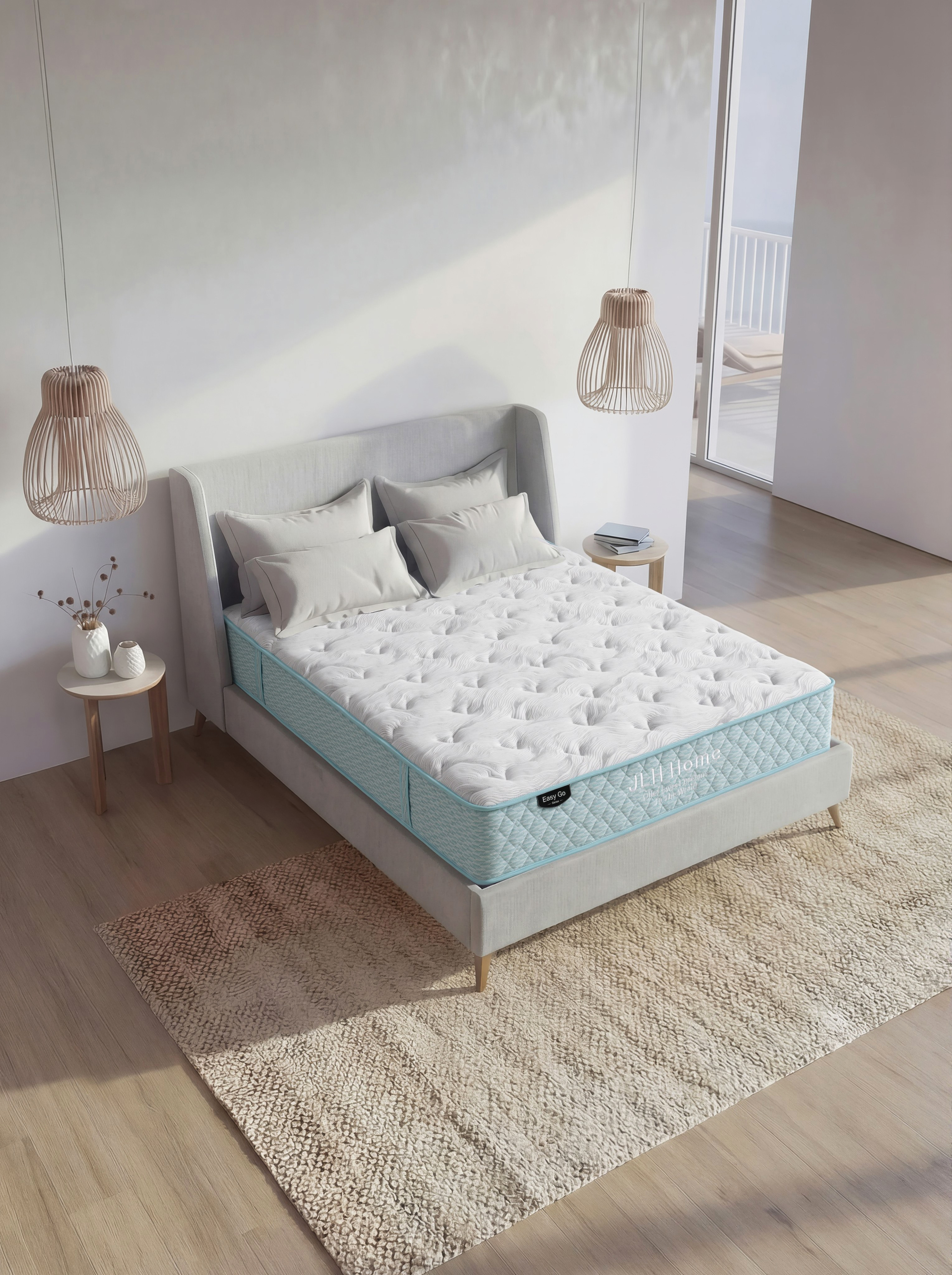
Real-world performance data supports this structural approach. In high-demand hospitality applications, such as the Hotel Gołębiewski Mikołajki in Poland, mattresses constructed with robust high-density layers successfully maintained comfort profiles across 689 rooms, resulting in high guest satisfaction ratings and a repeat order of 2,265 pieces. Similarly, luxury resort environments like Velaa Private Island in the Maldives utilize highly resilient foam structures to combat humidity-induced material softening, maintaining structural support over years of continuous operation. 
Data/Solution Comparison
Selecting the optimal wholesale mattress configuration requires balancing foam density with the intended application, packaging requirements, and logistics models. The table below outlines standard configurations for bulk procurement.
| Mattress Type | Target Comfort Layer Density | Support Core Specifications | Sagging Resistance Rating | Standard Business Logistics | Primary Shipping Methods |
|---|---|---|---|---|---|
| Hotel Mattress (Hybrid) | High (3.0+ lbs/ft³) | Pocket Spring + High-Density Foam Base | Excellent | MOQ: 1 Container; Delivery: 15-35 Days | Sea Freight, Air Freight, Rail Freight |
| Foam Mattress | Medium-High (2.5+ lbs/ft³) | High-Density Support Foam Core | High | MOQ: 1 Container; Delivery: 15-35 Days | Sea Freight, Air Freight, Rail Freight |
| Rolled-up Mattress | Medium (2.0+ lbs/ft³) | High-Resilience Compressed Foam Core | Medium-High | MOQ: 1 Container; Delivery: 15-35 Days | Sea Freight, Air Freight, Rail Freight |
Frequently Asked Questions (FAQ)
Does high foam density make a mattress feel excessively firm?
No. Density refers to the mass of the foam per unit volume (durability and resilience), while firmness is determined by Indentation Load Deflection (ILD). High-density foam can be formulated to feel soft and plush while still providing excellent, long-lasting support that prevents sagging.
How does roll-packing or vacuum compression impact foam density and sagging?
Vacuum roll-packing requires high-resilience foam to ensure full recovery. Low-density foam may suffer permanent cell damage during prolonged compression. Selecting high-density foam prevents cell wall rupture, allowing compressed mattresses to expand fully to their original dimensions and maintain long-term support.
Which certifications should B2B buyers look for to verify foam durability?
Buyers should prioritize products holding ISO9001 quality management, ISO 14001, BS7177 (UK fire safety compliance), and BSCI certifications. These verify that manufacturing processes, raw material sourcing, and physical testing meet rigorous international industrial standards.
Final Conclusion & Recommendations
To maximize the lifespan of wholesale mattresses, procurement teams must specify foam density based on the intended application. Partnering with a vertically integrated manufacturer ensures control over raw materials, consistent quality, and customized OEM/ODM design flexibility. For bulk orders, the standard MOQ is one container, which allows for an assortment of sizes and models to optimize shipping volume. Payments can be processed via T/T, L/C, PayPal, or cash, with fulfillment timelines averaging 15 to 35 days from deposit confirmation. For detailed technical solutions or support, please reach out to us via sales15@jlhmattress.cn.
About Us
Founded in 1992, Jinlongheng Furniture Co., Ltd. is a prominent manufacturer specializing in the sleep industry. The company operates a total production base of 630,000 square meters in Guangdong and features a monthly mattress production capacity of up to 120,000 units. With over 34 years of dedication, we focus on the research, innovation, and large-scale manufacturing of high-quality spring and foam mattresses, upholstered beds, compressed sofas, and pillows. Our facility holds major international quality and compliance certifications including ISO9001, ISO 14001, ISO 45001, ISPA, BS7177, and BSCI, serving premier hospitality projects and global brands in over 125 countries. 
Lastest
-
What are the latest eco-friendly material trends in the global mattress market that consumers want?
2026-06-30 -
What are the safest payment terms to negotiate with a new manufacturer of compressed sofas?
2026-06-30 -
How do overseas manufacturers handle replacement parts for damaged headboards or frames of upholstered beds?
2026-06-30 -
What third-party audit reports should I ask for to verify a mattress factory's quality management?
2026-06-30 -
What is the average MOQ for importing compressed sofas, and how much does price drop with larger volume?
2026-06-30
SUBSCRIBE
INQUIRY